Bangkok BTS and MRT Guide 2026: Ticket Types, Interchanges and the Airport Link Explained
Bangkok's rail network runs on 4 systems: 2 main BTS skytrain lines, 4 MRT subway lines, 1 airport rail link, and the BRT covering the southern end of the Silom corridor. All 4 have separate operators, tickets are not interchangeable, and changing between them means exiting and re-entering.
For visitors only 3 facts matter: Siam is the only crossing point between the two BTS lines, Asok is the main BTS-to-MRT interchange, and the old-town temple district is reachable only on the MRT Blue Line. Confirm fares and operating hours against the notices at each station.
2026 fares and hours: 17 to 62 baht per trip
BTS singles run 17 to 62 baht and MRT Blue Line singles 17 to 45 baht, banded by distance. Both systems mostly operate 06:00 to 24:00, at 3-minute headways at peak and 6 minutes off-peak. The airport link runs about 05:30 to 24:00 at 10 to 15-minute headways. Fares can change, so confirm at the station.
How the 4 systems divide up: skytrain for the malls, subway for the old town
The 2 main BTS lines follow the commercial and residential corridors across more than 60 stations. The MRT Blue Line is a loop of 38 stations and the only line reaching the old-town temple district. The airport link connects Suvarnabhumi to the city across 8 stations. The BRT extends the southern Silom corridor over 12 stations.
Interchange rules: separate tickets, 3 to 5 minutes on foot
The BTS and MRT belong to different systems, so changing means exiting and buying or tapping again. Asok to Sukhumvit takes about 3 minutes on foot, Sala Daeng to Si Lom about 4 minutes, and Mo Chit to Chatuchak Park about 5 minutes. Follow in-station signage for the current route.
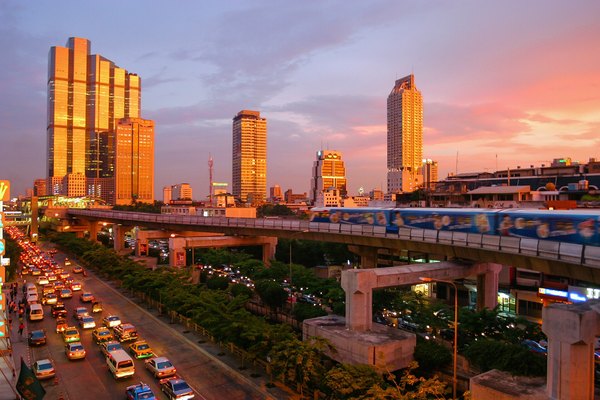
Bangkok rail tickets: 4 types and what they cost
Tickets come in 4 forms: singles, day passes, stored-value cards and airport link tickets. Short stays mostly combine singles with a day pass, and only long stays justify a stored-value card. Confirm fares and deposits against station notices.
Single tickets: machines take coins, counters change notes
BTS singles cost 17 to 62 baht and most ticket machines accept only 1, 5 and 10 baht coins, so notes must be changed at a staffed counter first. MRT machines issue tokens and some accept 20 to 100 baht notes. Counter queues run 5 to 10 minutes at peak, so carrying coins helps. Confirm fares and accepted denominations at the station.
Rabbit card: about 100 baht to issue, BTS and partner shops only
The Rabbit card costs about 100 baht to issue and must be loaded at purchase. The balance works on the BTS and at some chain retailers but not on the MRT. Validity and balance-expiry terms are revised from time to time, so confirm before signing up. It pays off only on stays of 4 days or more at 4 or more rides a day.
BTS day pass: 150 baht, breaks even at 5 rides
The BTS day pass costs about 150 baht for unlimited rides that day, so at an average single of 30 baht it breaks even from 5 rides. It is valid on the BTS only and excludes the MRT and the airport link. Passes are sold at staffed counters. Confirm the price and coverage at the station.
MRT cards and airport link tickets: each priced separately
An MRT stored-value card requires a deposit plus an issue fee, and the balance is usable on the MRT only. The airport link sells its own tickets, with Phaya Thai to Suvarnabhumi at about 45 baht. None of the 3 products is interchangeable, so each change means buying again. Confirm rates against each system's notice.
Bangkok's lines in 2026: 9 main routes and their stations
These are listed by system, each with station counts, journey times and the sights it reaches. Station counts and operating hours can change, so confirm each system's official notice.
BTS Sukhumvit Line: Mo Chit in the north to the outer suburbs
The Sukhumvit Line is the main north-south route, now past 40 stations, and takes about 70 minutes end to end. The stretch visitors use most is Mo Chit to Ekkamai, 11 stations in about 18 minutes, covering Chatuchak, Siam, Asok and the restaurant belt.
Exit 1 at Mo Chit leaves 600 metres on foot to Chatuchak Market. Asok connects to the MRT Blue Line. At the 07:30 to 09:30 peak, platforms often mean waiting 2 to 3 trains. Last trains mostly fall around 24:00, so confirm at the station.
BTS Silom Line: Siam is the only crossing point
The Silom Line has 14 stations and takes about 25 minutes end to end, running southwest from Siam to the Chao Phraya. Siam is its only crossing with the Sukhumvit Line, and the change needs no exit, at about 1 minute between platforms.
Saphan Taksin is 3 minutes on foot from Sathorn Pier, the entry point for river boats and free shuttles. Sala Daeng connects to the MRT with a 4-minute walk. Confirm last-train times at the station.
MRT Blue Line: a 38-station loop, the only old-town route
The MRT Blue Line is a loop of 38 stations taking about 90 minutes to circle, and the only rail route into the old-town temple district. Sanam Chai is 5 minutes on foot from Wat Pho, and the Wat Mangkon exits open onto Yaowarat Road.
It meets the BTS at 3 points — Asok, Sala Daeng and Mo Chit — each requiring an exit and 3 to 5 minutes on foot. Fares run 17 to 45 baht. Service is mostly 06:00 to 24:00, so confirm at the station.
MRT Yellow and Pink Lines: east and north suburban extensions
The Yellow Line has 23 stations and the Pink Line 30, both elevated monorails linking the eastern and northern residential districts, each with 2 to 3 interchanges to the BTS and the MRT Blue Line. Visitors mainly use them for suburban malls and wholesale markets.
Headways mostly run 5 to 10 minutes and the trains are short, so standing room is limited at peak. Fares are charged separately from the Blue Line. Confirm operating hours and interchange routes against each station's notice.
Airport rail link: Suvarnabhumi in 30 minutes for 45 baht
The airport rail link connects Suvarnabhumi to the city across 8 stations, reaching Phaya Thai in about 30 minutes for about 45 baht, at 10 to 15-minute headways, running roughly 05:30 to 24:00. Phaya Thai connects to the BTS Sukhumvit Line.
Makkasan allows a walking change to the MRT Blue Line in about 5 minutes. After the last service, a taxi or ride-hailing app is the only option. Confirm fares and last-train times at the station, and check ahead for late-night flights.
Don Mueang Airport: no rail link, A1 bus at 30 baht
Don Mueang has no direct rail connection. The A1 bus to BTS Mo Chit costs about 30 baht and takes 30 to 50 minutes at 5 to 15-minute headways. The A2 and A3 routes serve other city nodes at 30 to 50 baht.
A taxi into the city runs about 300 to 400 baht plus a 50 baht airport surcharge and tolls. Buses have mostly finished by the time late-night flights land. Confirm rates and departures against the notices on site.
Chao Phraya river boats: the alternative where rail does not reach
The orange-flag express boat costs about 16 baht a trip, calling at 20 piers at 10 to 20-minute headways; the blue-flag tourist boat costs about 30 baht a trip or about 150 baht for a day pass. Boarding is at Sathorn Pier by Saphan Taksin station, linking the old town and the riverside sights.
Last boats mostly fall around 18:00, so evenings need a land route. Floating pontoons sit at a steeper angle at low tide. Confirm fares and operating hours against pier notices.
Canal boats: a 15 baht shortcut at peak
Saen Saep canal boats run east to west along the central canal at about 10 to 20 baht a trip, beating surface traffic at peak, with Pratunam to the Thong Lo area taking about 25 minutes. Headways run 5 to 20 minutes and service is roughly 05:30 to 20:30.
Boarding crosses a floating plank during a stop of only about 20 seconds, which rules out large luggage. The hulls sit low and throw spray in the rainy season, with roll-down screens on both sides. Confirm fares and operating hours against pier notices.
BRT and shuttle buses: extending the southern Silom corridor
The BRT has 12 stations along about 15 km of dedicated lane, running from BTS Chong Nonsi to the southwest of the city at about 15 to 25 baht, at 5 to 10-minute headways. Visitors mainly use it for the southern riverside residential areas.
Some malls and hotels run free shuttles at 15 to 30-minute headways. Coverage and frequency are revised by each operator, so confirm before relying on one.
What Bangkok transport costs: fares and airport transfers
Spending comes down to rides per day and the airport transfer. The ranges below are typical and fares are revised by policy, so confirm at the station before buying.
Daily fares: singles up to 4 rides, a day pass from 5
Singles average about 30 baht, so 4 rides come to about 120 baht, under the 150 baht BTS day pass; from 5 rides the pass is cheaper. A plan that includes the old town adds MRT fares of 17 to 45 baht, which the pass does not cover. Confirm fares at the station.
Airport transfers: 4 options from 45 to 1,200 baht
The Suvarnabhumi rail link costs about 45 baht in 30 minutes; a metered taxi about 400 to 500 baht plus surcharge and tolls in 45 to 60 minutes; ride-hailing about 500 to 800 baht; a hotel transfer about 1,200 to 1,800 baht. Confirm rates and surcharges against the notices on site.
Where to stay for the fewest changes: picking a zone by line
The zone is effectively the transport budget: Siam saves a change, Asok gives both BTS and MRT, and the old town relies on the MRT Blue Line and river boats. Cross-city hops at peak often take 60 minutes, so confirm drive times against the day's traffic.
Siam: both BTS lines meet, fewest changes
Siam is the only crossing of the Silom and Sukhumvit lines, and the change needs no exit, at about 1 minute between platforms, with Chatuchak about 15 minutes away and Saphan Taksin about 12 minutes. The trade-off is the city's top rate band, so confirm live rates on your booking platform.
Asok and Phaya Thai: two systems and the airport link
Asok is 3 minutes on foot from the MRT Blue Line and the most-used BTS-to-MRT change. Phaya Thai connects directly to the airport link, reaching Suvarnabhumi in about 30 minutes, which suits early departures. Confirm fares and last-train times at the station.
Peaks and queues: avoid the 07:30 and 17:00 windows
Peaks run 07:30 to 09:30 and 17:00 to 19:30, when interchange platforms often mean waiting 2 to 3 trains, about 6 to 10 minutes, with 5 to 10 minutes at ticket counters. Carrying coins or moving after 10:00 saves most of that. Confirm live headways against station notices.
Luggage and station rules: large cases are hard to board at peak
Both systems screen bags, with hand luggage opened for a check of about 10 seconds. Eating and drinking are barred on board, and some stations run escalators in one direction only, so large cases mean stairs. A 28-inch case is hard to board at peak, which makes a ride-hailing app the better choice. Confirm the current rules at the station.
FAQ
Q. Rabbit card or single tickets in Bangkok?
Up to 4 rides a day, single tickets cost less at 17 to 62 baht each; from 5 rides a BTS day pass at 150 baht wins. A Rabbit card only suits stays of 4 days or more with heavy BTS use, and the issue fee is about 100 baht. Confirm fares against station notices.
Q. Can one ticket be used on both the BTS and the MRT?
No. The two systems have separate operators, so changing means exiting and buying again or tapping a different card, with 3 to 5 minutes on foot between stations. Asok and Sukhumvit, and Sala Daeng and Si Lom, are the 2 main interchange pairs. Follow in-station signage for the current route.
Q. What is the cheapest way from Suvarnabhumi Airport into the city?
The airport rail link reaches Phaya Thai in about 30 minutes for about 45 baht, the cheapest option. A metered taxi runs about 400 to 500 baht plus the airport surcharge and tolls, taking 45 to 60 minutes. Confirm fares and surcharges against the notices on site.
Q. Is there a rail link at Don Mueang Airport?
Don Mueang has no direct rail connection, so the main option is the A1 bus to BTS Mo Chit at about 30 baht, taking 30 to 50 minutes. Airport buses and taxis also run, with taxis into the city at about 300 to 400 baht. Confirm rates against the notices on site.
Q. How late do the BTS and MRT run?
Both mostly run 06:00 to 24:00, with last trains varying by terminus and some branches finishing before 23:30. The airport rail link runs about 05:30 to 24:00. Last-train times are adjusted often, so check the station notice on the day rather than working from old timetables.
Q. Are the trains too crowded to board at peak?
Peaks run 07:30 to 09:30 and 17:00 to 19:30, and at interchanges such as Siam and Asok platforms often mean waiting 2 to 3 trains, or about 6 to 10 minutes. Large luggage is hard to board at peak, so a ride-hailing app or avoiding those 2 windows works better.